Henry Louis Gates Jr., the famed African-American literary scholar and director of the Du Bois Institute at Harvard University, recently reflected the following in an interview on National Public Radio: If it weren't for affirmative action, he would not have been admitted to Yale University, regardless of how high his credentials were and he would not have had the opportunities to demonstrate his talent over the past four decades.[1]
Gates' admission reflects a fundamental problem with affirmative action. It works.
I had the opportunity to reflect on that out loud in a discussion at the Race and Higher Education conference in Grahamstown last month when I asked: 'Are there no mediocre white people in South Africa? Is every white person hired, every white person offered admission to institutions of learning, an excellent candidate?'
My rhetorical question was premised upon what Gates and many other highly achieved blacks know and that is the myth of white supremacy is the subtext of the 'qualifications' narrative that accompanies debates on affirmative action.
Read more here
Friday, August 19, 2011


Tuesday, August 16, 2011
Sunday, August 14, 2011
It's 'bBlackademic: young and black in academia
I wasn't necessarily in love with my major department at my undergraduate institution, though I had some fairly decent professors. Then came the semester I took Blacks in Film as an elective. I then took African American Studies, and then a summer semester Harlem Renaissance course at a local community college. Each of those professors brought a combination of passion and academic rigor to the courses that I honestly had not seen in many of my other my classes. What was different? Aside from one high school teacher, this was the first time that I was gifted academic knowledge by someone who reflected my cultural background and experience.
This view probably mirrors many other former and current Black learners, even with caring white teachers. However, a YourBlackWorld.com study reports that 42% of all African Americans at predominantly white campuses never had a single black professor during four years of college. Seventy-four percent of the same students only had one black professor in a field outside of African American studies. On a subconscious level, this was in part why chose a career in academia, why I became a Blackademic.
These results indicate a phenomenon far beyond not having enough black faculty on campuses across the US. It means that there are too few examples for black students to model themselves after and that many don't see the option. Dr. John Barker, Assistant Provost for Undergraduate Education at the University of Miami gives a prime example. When he speaks to new groups of mostly minority students, he has them do a visualization exercise, in which students picture a faculty member and then give a description. "Nine out of 10 picture one who is white," says Barker.
Read more here
Thursday, August 11, 2011
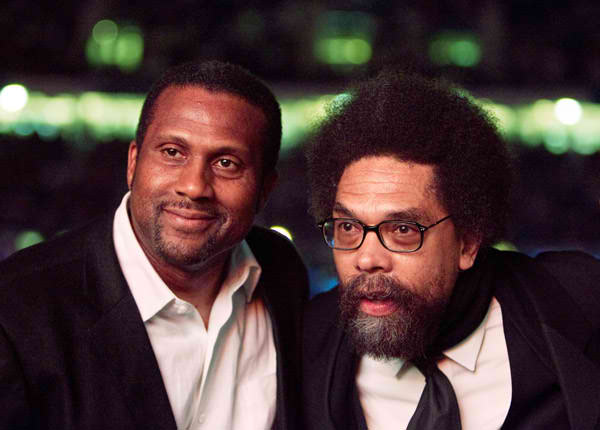
In Defense of Tavis and Cornel
I am friends with Tavis Smiley and Cornel West, so it has been hard for me to watch and hear the often nasty attacks leveled at them both. While no person is above criticism, and I would not have used some of their words, much of what I'm hearing about them just leaves me shaking my head in wonder about where we are going as a nation that has so many needs. The Smiley and West "poverty tour" has presented their critics with another opportunity to accuse them of everything from grandstanding to undermining President Barack Obama. That is nonsense and reveals a more significant truth with which we all must deal: some people so hate the messenger that they can not accept the message no matter how important it may be. It has gotten to a point where their critics seem to be saying "if Smiley and West are for it, then I am against it."
Read more here
Read more here
Dr. Cornel West, and Tavis Smiley Poverty Show full in effect…
(ThyBlackMan.com) “Me and Tavis, we’re going to remind you who Martin really was.” – Dr. Cornel West
Now that Dr. Cornel West and television personality Tavis Smiley have set out like an Afro-centric version of “Thelma and Louise” on a tour denouncing the Obama administration for what the two decry as a lack of focus on the poor, the only real interest I have is how this road trip ends. Will West-Smiley lock hands and drive over the cliff or are they apt to take us along for the ride and the plunge?
To say that I am disappointed in Dr. West and Tavis is an understatement. During one of the most difficult periods African-Americans have faced in the post-Reconstruction era, we should expect more from Black elites who claim to possess some special anointing to lead the masses. It is not a matter of their criticism of President Obama that disturbs me; it is how they are going about their critique and the sense that much of it is personal and has little to do with the general welfare of our community. There is no question that this administration has a lot of work to do to improve economic conditions for Blacks, every monthly employment report from the Bureau of Labor Statistics reads like an epitaph for Black America. Still, to simply lay all the blame at the foot of 44, when the policies of 43 got us into this mess, suggests an analysis by West and Smiley that is either rooted in ignorance or intentionally misleading. Given the truly historical circumstances that created the present crisis, and the manner in which current inequities have been cumulative, the idea that President Obama is somehow fully responsible for our present condition is absurd.
Read the rest here
Now that Dr. Cornel West and television personality Tavis Smiley have set out like an Afro-centric version of “Thelma and Louise” on a tour denouncing the Obama administration for what the two decry as a lack of focus on the poor, the only real interest I have is how this road trip ends. Will West-Smiley lock hands and drive over the cliff or are they apt to take us along for the ride and the plunge?
To say that I am disappointed in Dr. West and Tavis is an understatement.
 During one of the most difficult periods African-Americans have faced in the post-Reconstruction era, we should expect more from Black elites who claim to possess some special anointing to lead the masses. It is not a matter of their criticism of President Obama that disturbs me; it is how they are going about their critique and the sense that much of it is personal and has little to do with the general welfare of our community. There is no question that this administration has a lot of work to do to improve economic conditions for Blacks, every monthly employment report from the Bureau of Labor Statistics reads like an epitaph for Black America. Still, to simply lay all the blame at the foot of 44, when the policies of 43 got us into this mess, suggests an analysis by West and Smiley that is either rooted in ignorance or intentionally misleading. Given the truly historical circumstances that created the present crisis, and the manner in which current inequities have been cumulative, the idea that President Obama is somehow fully responsible for our present condition is absurd.
Read the rest here
Saturday, August 6, 2011
An Interracial Fix for Black Marriage
"At this point in my life," says Audrey, age 39, "I thought I'd be married with children." A native of southeast Washington, D.C., and the child of parents who are approaching their 50th wedding anniversary, Audrey seems like the proverbial "good catch"—smart, funny, well-educated, attractive.
Audrey earns a good living, too, with an income from management consulting that far surpasses what her parents ever made. Her social life is busy as well, filled with family, friends and church.
What Audrey lacks is a husband. As she told me, sitting at a restaurant in the fashionable Dupont Circle neighborhood of the nation's capital, "I'm trying to get to a point where I accept that marriage may never happen for me."
Audrey belongs to the most unmarried group of people in the U.S.: black women. Nearly 70% of black women are unmarried, and the racial gap in marriage spans the socioeconomic spectrum, from the urban poor to well-off suburban professionals. Three in 10 college-educated black women haven't married by age 40; their white peers are less than half as likely to have remained unwed.
Read more here
New HIV Numbers Released: Bad News for African-Americans
On Wednesday the Centers for Disease Control released its latest round of multiyear HIV statistics, and once again the rates of African-American infection, especially among Black male homosexuals, were causes for concern to say the least.
Overall the number of new HIV infections in the United States remained stable between 2006 and 2009 with about 50,000 infections each year. However, the increase in the number of young Black homosexuals was alarming.
“Not only do men who have sex with men continue to account for most new infections, young gay and bisexual men are the only group in which infections are increasing, and this increase is particularly concerning among young African-American MSM,” said CDC director Thomas Frieden, M.D.
Black male homosexuals were the only subgroup with a notable increase—48 percent during that time period, according to CDC estimates—in new infections during that time period.
Read more here
Overall the number of new HIV infections in the United States remained stable between 2006 and 2009 with about 50,000 infections each year. However, the increase in the number of young Black homosexuals was alarming.
“Not only do men who have sex with men continue to account for most new infections, young gay and bisexual men are the only group in which infections are increasing, and this increase is particularly concerning among young African-American MSM,” said CDC director Thomas Frieden, M.D.
Black male homosexuals were the only subgroup with a notable increase—48 percent during that time period, according to CDC estimates—in new infections during that time period.
Read more here
Subscribe to:
Posts (Atom)